
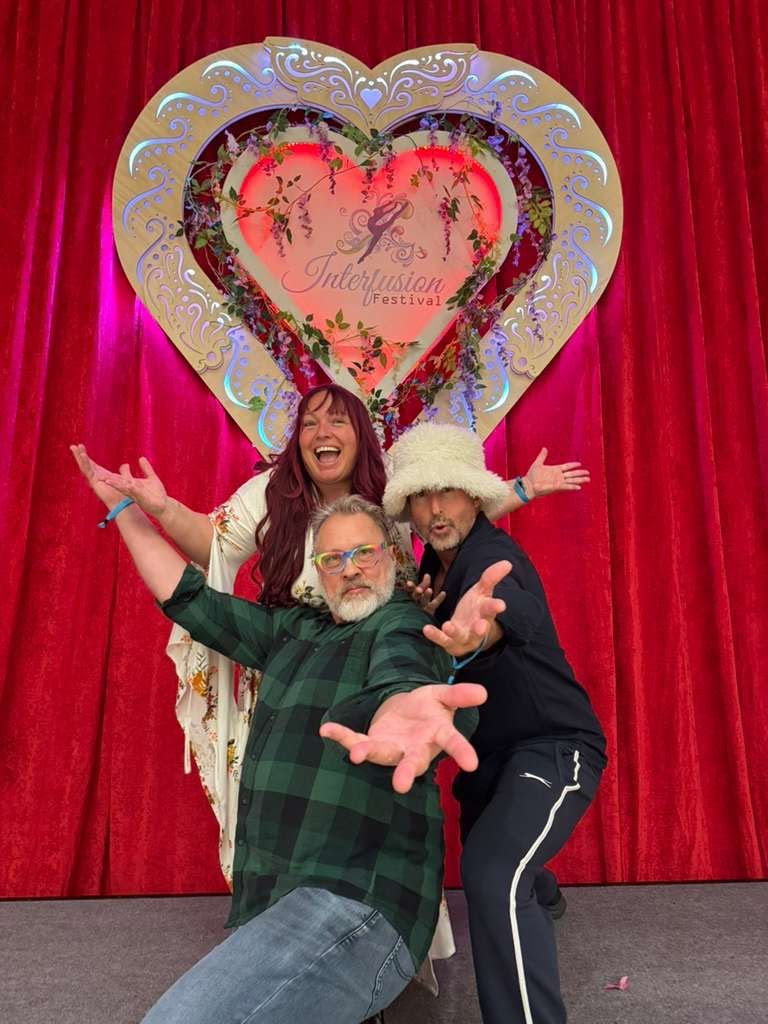
Recently, I had the honor of teaching at the Interfusion Festival in Arlington, Virginia! Here’s a fun, slightly cheesy picture of yours truly with EverydayTantra.com’s Monique Darling & Peter Petersen.
I was asked to facilitate a group conversation that would help attendees have a more powerful and positive festival experience… And the topic I chose is one that I think a lot of us struggle with when we attend really kick-ass, super fun events… The topic: Regret Vs. Being Spontaneous (at Festivals).


Here’s the talk description: How do we know when we’re being spontaneous and wanting something we didn’t plan for VS. getting caught up in the moment and pushing through/past our boundaries because of a fawning response or FOMO?
And I wanted to share with you some of what was covered in this talk because I think it might be super useful for you, a loved one, or your friends… (Feel free to share this post to them if you feel called to)… Hope these ideas help… Enjoy!
Regret vs. Being Spontaneous
(At Festivals, On Dates, & Everywhere In Between)
Festivals and retreats are magical, intimacy pressure cookers.
There’s music. Connection. Euphoria. Late nights. New experiences. Big feelings. Big possibilities.
And suddenly Latenight-You finds yourself doing things that Yesterday-You swore you were a hard no.
But here’s the thing: this isn’t just a festival issue. This same dynamic shows up on dates, in new relationships, during hookups, and in moments of unexpected intimacy.
One of the trickiest skills in dating, intimacy, and connection is telling the difference between being spontaneous and doing something you’ll later regret.
In the moment, they can feel identical—same butterflies, same adrenaline, same “well, this escalated quickly” energy.
The Empathy Gap (a.k.a. “Why Past You and Present You Disagree”)
In psychology, the empathy gap describes how hard it is for us to accurately predict our choices, desires, and boundaries when we’re in a different emotional or physical state than we are right now.
[Here’s a great podcast on the subject]
When we’re calm, rested, and grounded, most of us are pretty good at saying:
- “That’s a no for me.”
- “That’s a hard limit.”
- “I’ll take my time with that.”
But when we’re in a heightened state—turned on, chemically altered, sleep-deprived, emotionally connected, euphoric, or swept up in the moment—our boundaries can feel more flexible, more wibbly-wobbly, than we expected.
This doesn’t mean you’re reckless. It means you’re human.
Heightened States Aren’t Just About Substances
A heightened state can come from:
- Alcohol or drugs
- Dancing your ass off
- Erotic chemistry
- Feeling chosen or deeply seen
- A great first date that suddenly turns very intimate
- “This might never happen again” energy
Cue the classic sex-ed joke:
“Everyone says they’d never eat ass… until they’re hot, heavy, and very enthusiastic.”

Or the person who always uses condoms… until everything feels so intimate and electric that the rules quietly dissolve.
And then comes the next day:
- “Why did I say yes?”
- “That was too much.”
- “I crossed my own line.”
That’s regret—and it deserves curiosity, not shame.
The Difference Between Spontaneity and Regret
Here’s the key distinction:
Spontaneity isn’t about losing control; it’s about choosing to play.
Real spontaneity leaves room to:
- Pause
- Check in with your body
- Ask a question
- Change your mind
- Slow things down without feeling like you’re ruining the moment
Regret usually sneaks in when FOMO, people-pleasing, or a fawn response grabs the steering wheel and whispers:
“Just go with it… don’t be difficult… this is what being open looks like.”
That’s why it’s important to remind yourself: “If you didn’t feel like you could say no, it wasn’t really a yes.”
And it’s not always easy to catch yourself when you’re in that wibbly-wobbly state and feeling that you can’t say no.
When Excitement Drives Faster Than Awareness
Sometimes we’re not actually choosing—we’re coping.
Fawning is a nervous-system response where we prioritize someone else’s comfort, desires, or approval over our own boundaries.
It can sound like:
- “It’s fine, really.”
- “I don’t want to disappoint them.”
- “I’ll deal with my feelings later.”
Add in FOMO—especially on the last night of a festival, or when a date feels rare or special— when you don’t want something to end! It’s like the stargate of opportunity is closing and you don’t want to miss your chance! And suddenly we’re rushing to do the thing, stepping on the gas as we go into the corner, lose “control” and start skidding right over our own boundaries even if we’re trying to pump the brakes.

Introducing: Your Spontaneous Bottom Lines
Here’s a new concept for you to try on: Spontaneous Bottom Lines.
These are the boundaries that YOU know don’t change, even when you’re excited, connected, tired, turned on, or swept up.
These are boundaries you are CERTAIN need to stay in place for the good of all involved.
Think of them as guardrails, not cages.
Examples might be:
- “No condoms = no penetration.”
- “I don’t escalate physical intimacy on the first date.”
- “I don’t make big relationship decisions in altered states.”
- “If I feel pressured, rushed, or foggy, we pause.”
You decide these ahead of time, when your nervous system is calm and your brain is fully online.
How to Stick to Them (Without Killing the Vibe)
A few gentle supports:
- Write your bottom lines down before events or dates
- Share them with a trusted friend
- Practice simple phrases like:
“This feels good, and I need to slow down.”
“I’m a yes to connection, not to escalation.” - Build in pauses—water, sleep, daylight, a walk, a call to a trusted friend
Spontaneity doesn’t disappear when you have boundaries. It gets safer, juicier, and more sustainable.
The Real Takeaway
Regret isn’t proof you failed. It’s information.
And spontaneity isn’t the absence of boundaries—it’s knowing which ones matter most, even when everything feels amazing.
Learning to tell the difference helps you:
- Take risks on purpose
- Stay aligned with yourself AND be flexible and able to respond in the moment
- Walk away feeling grounded, proud, and intact
Instead of replaying the moment later wondering how your mouth said yes while your nervous system quietly muttered, “uhhhh…”
That’s not cautious. That’s skillful. (And it’s okay to not be perfect at this — It might take some practice and some screwing up, but it’s the learning-curve kind of screw up rather than the violating your values screw up.)

A 2-Minute Reflection: Spontaneity With Guardrails
You can do this right now, in about two minutes.
No journaling required—though you’re welcome to write if that helps.
Step 1: Think Ahead (30 seconds)
Picture yourself in a heightened state:
- You’re excited
- You feel connected
- The moment feels rare or special
- Things are escalating quickly
Don’t judge the image. Just notice it.
Step 2: Name Your Bottom Lines (30 seconds)
Ask yourself:
- What are the 1–3 boundaries I don’t want to negotiate when I’m tired, turned on, or swept up?
- What choices do I want Future Me to feel good about tomorrow morning?
These are your Spontaneous Bottom Lines.
Step 3: Check Your Body (30 seconds)
Now imagine holding those boundaries in the moment.
Notice:
- Does your body feel steadier or more tense?
- Do you feel relief, clarity, or resistance?
Your body often knows before your brain does.
Step 4: Practice the Pause (30 seconds)
Silently rehearse one sentence you could say if you needed to slow things down:
- “This feels good, and I need a pause.”
- “I want to stay connected without escalating.”
- “I’m excited—and I still want to go slow.”
If you can imagine yourself saying it, you’re far more likely to say it when it counts.
Spontaneity doesn’t mean saying yes to everything.
It means choosing your yes with enough awareness that you can still recognize yourself afterward.
That’s not overthinking. That’s self-trust in action.
That’s it for today. I hope you leave a comment or send me an email and share an ah-ha you’re having about regret vs spontaneity.
I’d love to see your name show up in my inbox or in the comments. And I hope to see you in person at one of the workshops or festivals that I’ll be teaching at this year.
Head to my Calendar see what and where I’m going to be next…
Sending you lots of FUN and less FOMO!
REiD